
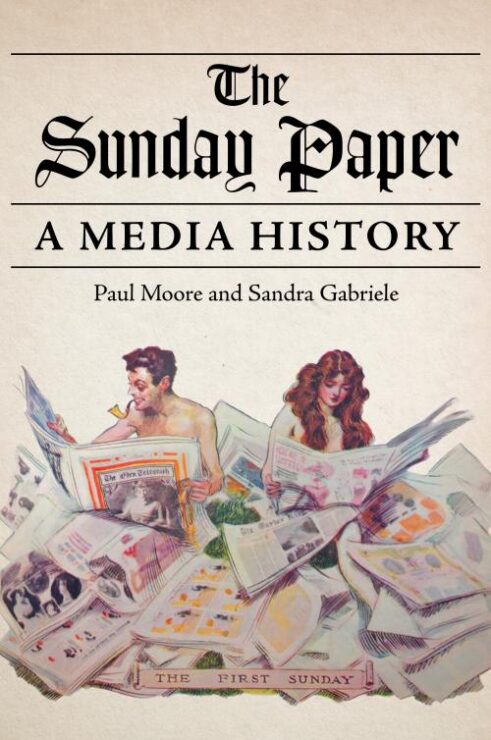
The American Sunday paper of the 1890s transformed the daily edition with inserts and supplements of all shapes and sizes. Each asked readers to do more than read, but to interact with the materiality of the paper as a form of leisure. The Sunday paper became so large and voluminous it needed to be organized: managed and collected over time, shared across an entire family. Subscriptions enhanced the economic success of the Sunday paper by helping to produce expert reading subjects. Collecting series of supplements and clipping coupons encouraged readers not to treat Sunday papers as disposable, but instead parts of cultural and consumer life that could gain value if saved. In illustrated features, circulation became an ideal in its own right, achieved through intermediality. Syndicated for national reach, the Sunday paper was the basis for a mass mediated popular culture. Indeed, the Sunday Paper became so reliant on the circulation of its popular supplements as to beg the question if it even remained a newspaper at all.
A virtual presentation by Sandra Gabriele, Vice President, Academic and Provost, Ontario College of Art & Design University, Toronto, Canada, and Paul Moore, Professor of Sociology, Toronto Metropolitan University, Toronto, Canada and past President of the Film Studies Association of Canada